Clinical Intelligence at Your Fingertips

Elevating Ambulatory ECG

Peerbridge Health delivers high-fidelity physiological signals through a platform designed for real clinical workflows—keeping care and billing with the physician while transforming complex data into clear, decision-ready insights.

The result: faster answers, earlier intervention, and care that moves at the pace clinicians need.

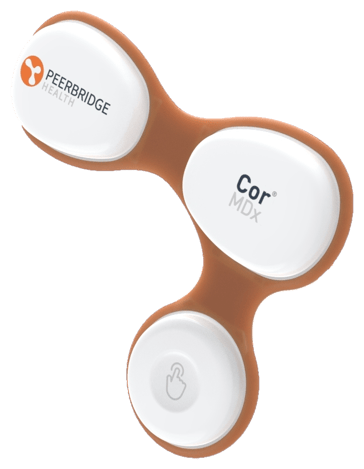
Cor Device
Picture of an orange cor device from Peerbridge Health.
peerbridge-image-2

Prevention and Intervention with Cor©

Enabling Earlier Insight

Early detection and triage can significantly improve patient outcomes and alleviate the strain on healthcare systems. Cor captures high-fidelity signals that help clinicians identify meaningful changes sooner, enabling timely intervention, informed decision-making, and more proactive management before conditions escalate.


list-icon-1

Designed to Fit How Clinics Actually Work.

Peerbridge Cor is an FDA-cleared ambulatory ECG system that pairs a comfortable wearable with a clinic-friendly platform that integrates seamlessly into existing workflows, producing consistent, decision-ready reports without adding complexity or administrative burden.

list-icon-3

Earlier Detection. Clearer Clinical Decisions.

Built on Einthoven's Triangle, Cor captures 31 cardiac rhythms with high-fidelity signal quality that delivers clear P-wave definition and precise QRS morphology so clinicians can detect change sooner and act with confidence.

list-icon-2

Economics That Support Sustainable Care.

With a low-lift rollout and physician-favorable billing model, Cor keeps billing with the physician & the clinic–supporting predictable margins, straightforward reconciliation, and long-term financial sustainability.

Peerbridge Cor: AI enabled, FDA-cleared ECG Wearable Reimagining the Future of Cardiac Care

The Cor platform’s advanced ambulatory ECG capabilities transform healthcare, enabling faster, more accurate, and affordable diagnoses that enhance patients’ quality of life.

circle-check
Only patented 3 lead, 2-channel wireless AECG patch with Einthoven Triangle design
circle-check

Proprietary algorithm to compute derived 12 lead (under trial)

circle-check
Explainable AI markers for Hospital Grade Indications (under trial)
circle-check

Hospital-grade diagnostics and monitoring anywhere, anytime (under trial)


Testimonials

What Physicians Say About Us

Where Are We Headed Next?

An Expanding Clinical Insight Platform

(*all currently under investigation)

Heart failure emerges from multiple interconnected mechanisms, yet current diagnostic tools remain fragmented and episodic. Peerbridge is working to unify the evaluation of these distinct drivers of cardiac decline within a single, remote wearable platform.
Our technology transforms high-fidelity signal capture into decision-ready clinical intelligence, allowing for a comprehensive assessment of a patient's physiological status. Our innovation roadmap focuses on expanding these insights across the core mechanisms that drive cardiac decline, all through a unified wearable solution.

The Future of Peerbridge Health:
Enabling Hospital-Grade Diagnostics and Monitoring Across the Care Continuum

strathoscope

Ambulatory ECG

Continuous monitoring of a patient’s heart activity while they go about their daily activities outside of a clinical setting.

Primary Care

Primary Care

On-demand diagnostics and screening tools with <10 minutes of wear.

notepad and pen

Medical Research Professionals

Enabling simplified and accelerated research.

Latest News & Articles

Peerbridge Health Announces Funding Round Close, FDA 510(k) Submission of Next-Gen Device Appoints - Dan Reuvers to the board and expands sales team

Despite heart disease being the leading cause of death in the U.S., millions lack access to affordable, accurate diagnostics. Peerbridge Health, the company transforming how heart disease

Peerbridge Health Unveils Cor MDx Next-Generation IoT ECG Wearable at HIMSS Global Health Conference

Wireless connectivity enablement with AT&T helps Peerbridge expand access to AI-driven cardiac care Peerbridge Health is ushering in the next generation of remote cardiac monitoring at the

Peerbridge Health Unveils COR-INSIGHT Trial to Validate Revolutionary AI-Enabled Cardiac and Cardiopulmonary Diagnostics & Monitoring

Inexpensive wearable technology for diagnostics and monitoring has the power to transform cardiac care Peerbridge Health has announced the launch of its landmark COR-INSIGHT Trial, which

heart

Electrical: Expanding ECG Beyond Rhythm

Why it matters: Conduction defects, electrical dyssynchrony, arrhythmias, and silent ischemia often precede clinical deterioration and guide downstream intervention.

Historically measured by: Holter monitors, event monitors, in-clinic ECGs, stress testing, and EP study—often episodic and rhythm focused.

scan

Structural: Illuminating Cardiac Remodeling

Why it matters: Structural changes such as chamber enlargement or hypertrophy reflect chronic stress on the heart and create the substrate for life-threatening arrhythmias.

Historically measured by: Imaging studies (echocardiography, MRI, CT), which are costly, episodic, site-dependent, and with limited utility.

electrical

Functional: Understanding How the Heart Performs

Why it matters: Functional impairment—systolic or diastolic—affects how efficiently the heart pumps and responds to metabolic demand during daily activities.

Historically measured by: Imaging studies, right heart catheterization, stress testing, and indirect lab markers.

microscope

Hemodynamic: Detecting Changes in Cardiac Efficiency

Why it matters: Shifts in cardiac output and filling pressures are leading indicators of subclinical congestion, often driving symptoms and escalation of care.

Historically measured by: Invasive monitoring, right heart catheterization, imaging studies, and indirect lab markers.

stetho

Hemodynamic: Detecting Changes in Cardiac Efficiency

Why it matters: Shifts in cardiac output and filling pressures are leading indicators of subclinical congestion, often driving symptoms and escalation of care.

Historically measured by: Invasive monitoring, right heart catheterization, imaging studies, and indirect lab markers.